Product architecture
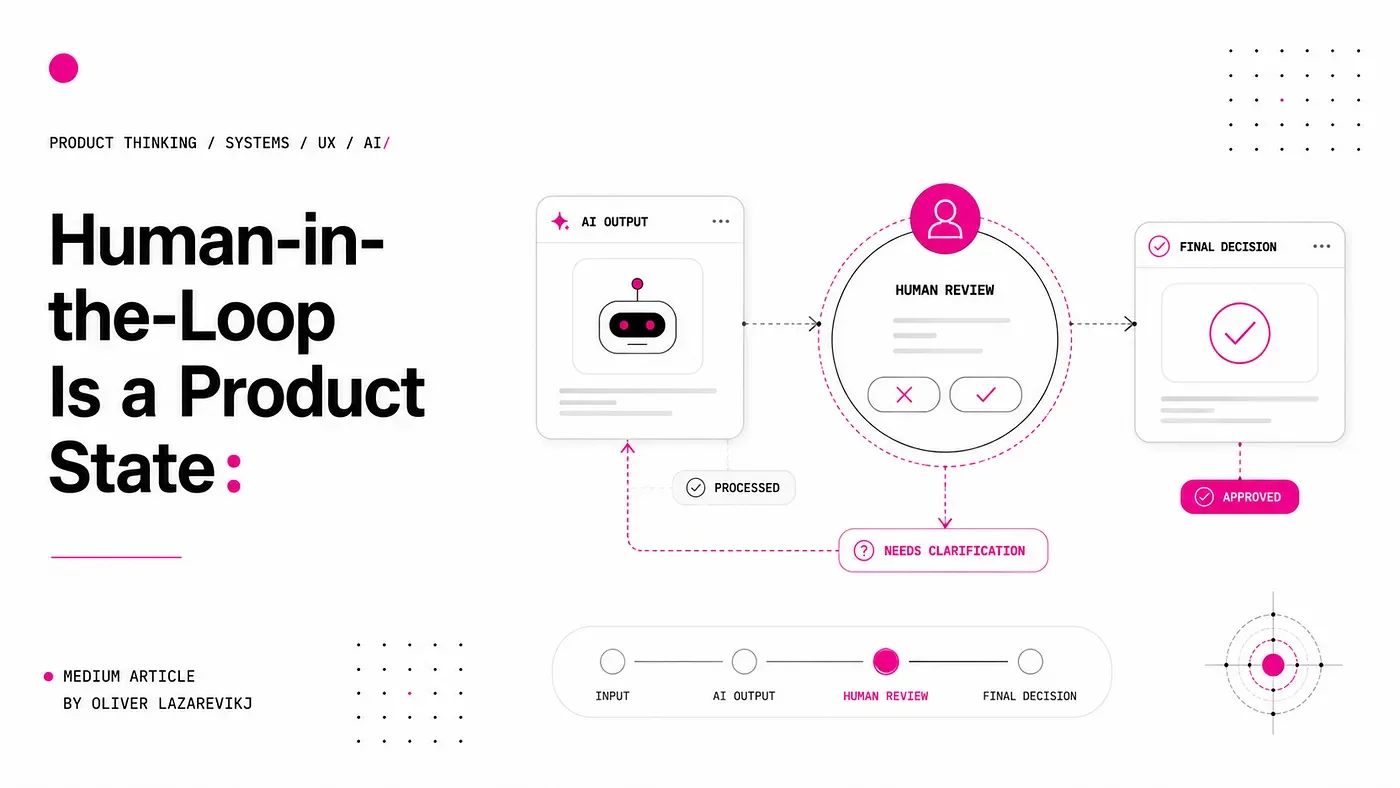
Human-in-the-Loop Is a Product State
Why approval, rejection, editing, and recovery belong in the product state model of every human-supervised workflow.
Human approval is not an exception to automation.
It is part of the workflow.
Many automated and AI-powered products are designed around two overly simple outcomes:
The system performs the action, or the system fails.
Real business processes rarely work that way.
An action may need to wait for approval. A person may edit it before approving it. The request may expire, be rejected or fail after approval. The workflow may need to recover and continue later.
If these situations are not designed as explicit product states, they turn into confusing notifications, broken processes and manual work outside the system.
Approval is not one button
Adding an “Approve” button does not create a complete human-in-the-loop workflow.
The product must also explain:
- What is being approved
- Why approval is required
- What information was used
- What will happen after approval
- Whether the action can be edited
- How long the approval remains valid
- Whether the result can be reversed
Without this context, the person is not making an informed decision. They are simply accepting the system’s recommendation.
Good approval UX supports judgment rather than replacing it with another click.
The states every approval workflow should consider
Not every product needs every possible state, but most automated workflows require more than “approved” and “rejected.”
1. Awaiting approval
The system has prepared an action but cannot continue without human confirmation.
The user should see what is waiting, who is responsible for reviewing it and whether there is a deadline.
The workflow should not simply disappear into a notification inbox.
2. Approved
A person has authorised the proposed action.
The system should record who approved it, when they approved it and which version they reviewed.
This matters because the content or underlying data may change between preparation and execution.
3. Rejected
The reviewer has decided that the action should not continue.
Rejection should not be treated as a dead end.
The product may need to capture a reason, notify the workflow owner or return the action for revision.
4. Edited before approval
Sometimes the recommendation is useful, but not completely correct.
A sales manager may adjust an AI-generated offer. An operations lead may change the amount of a refund. A content owner may rewrite part of a generated message.
The product should clearly distinguish between the original recommendation and the final approved version.
That difference is useful evidence for improving the system later.
5. Expired
Some approvals lose relevance over time.
A price may change. A customer may respond. Inventory may no longer be available. The data used to prepare the action may become outdated.
The product should define what happens when approval does not arrive in time.
Does the request close, refresh its data or return to the beginning of the workflow?
6. Failed after approval
Approval does not guarantee execution.
A connected service may be unavailable. A payment may be declined. A record may have changed. The user’s permissions may no longer be valid.
The product must separate “approved” from “completed.”
Otherwise, users may believe an action happened when the system only received permission to attempt it.
7. Resumed
A workflow may need to continue after a delay, correction or technical failure.
When it resumes, users need to know whether the original approval remains valid or whether the modified action requires new approval.
Resuming without checking this can cause the system to execute something different from what the person originally reviewed.
Design the complete decision lifecycle
A reliable approval workflow should show a clear sequence:
Proposed → Awaiting approval → Approved or rejected → Executing → Completed or failed
But the real value is in the transitions between those states.
What happens when the reviewer edits the proposal?
Who is notified after rejection?
Can another person approve an expired request?
Does a failed action retry automatically?
When is new approval required?
These questions cannot be solved by interface polish alone. They require product, operational and technical decisions.
Human involvement does not weaken automation
There is a tendency to view human approval as friction that should eventually be removed.
Sometimes it should be.
But in high-risk, high-value or irreversible workflows, human judgment is part of the system’s value.
The goal is not to eliminate every approval.
The goal is to make each approval informed, efficient and traceable.
When awaiting approval, rejection, editing, expiration, failure and recovery are designed as first-class product states, automation becomes easier to trust and easier to operate.
Human-in-the-loop is not a temporary workaround.
It is product architecture.