AI & UX
Agent Permissions Are UX
Identity, access, scope, approvals, and history: the product decisions that make AI agents understandable and trustworthy.
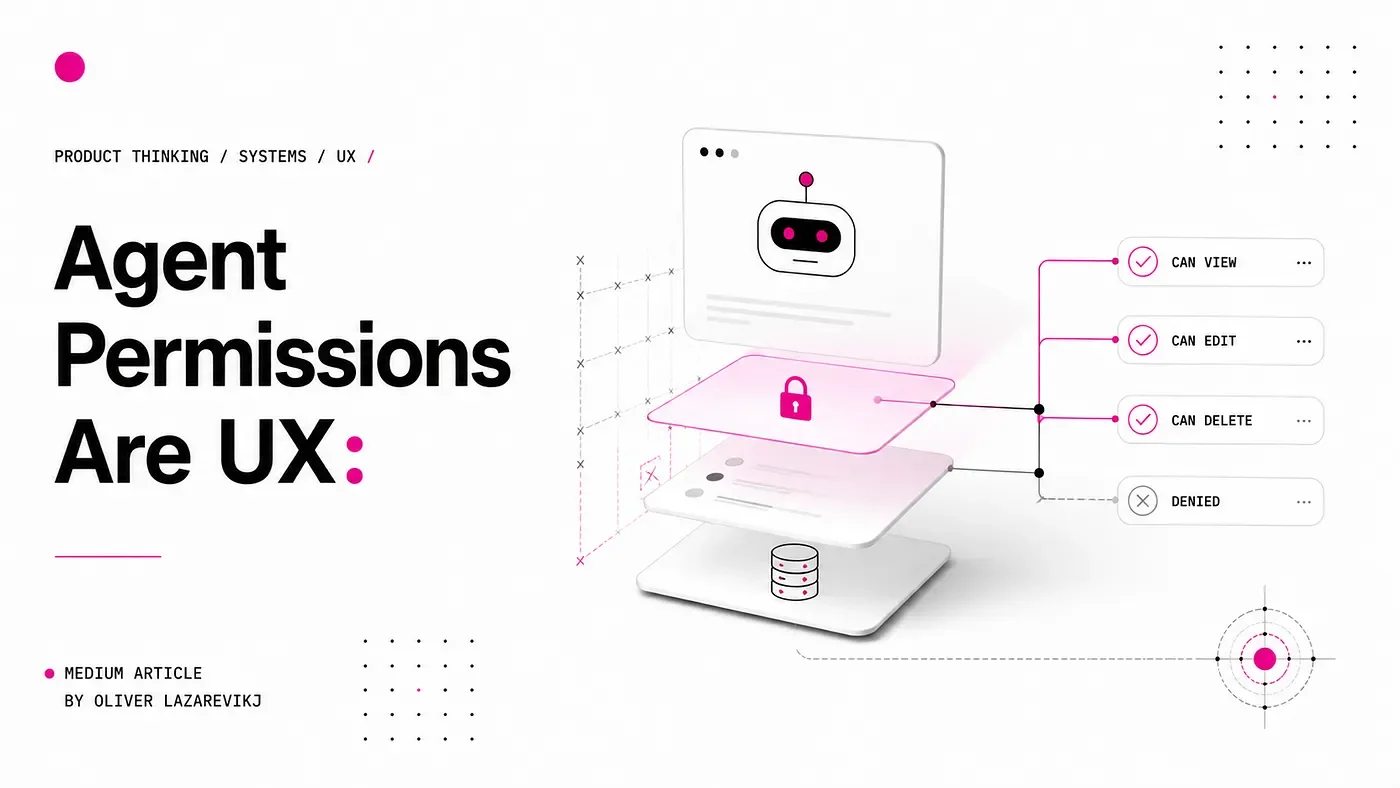
The most important screen in an AI product may be the one explaining what the agent is allowed to do.
A lot of AI products still treat permissions as a technical requirement: a few checkboxes, a confirmation dialog and a link to the privacy policy.
But when an AI agent can access company data, communicate with customers, update records or trigger business processes, permissions become part of the product experience.
They determine whether users trust the system enough to use it.
A polished chat window can make an AI product feel approachable. It cannot explain what happens after someone presses Enter.
Before an agent acts, users need clear answers to five questions.
1. Who is acting?
The product should make it obvious whether an action is being performed by the user, an automated workflow or a specific AI agent.
This becomes especially important when several agents, team members and integrations operate inside the same system.
“Your request was processed” is not enough.
Users should be able to see which agent initiated the action, which account authorised it and which rules were applied.
Identity creates accountability.
2. What can the agent access?
Connecting an agent to a CRM, inbox or project-management system does not mean it should automatically access everything inside it.
Users need to understand:
- Which systems are connected
- Which records the agent can read
- What information it can modify
- Whether access is temporary or persistent
- Who can change those permissions
This information should not be buried inside a settings page that nobody visits.
Access should be visible when and where it matters.
3. What actions can it perform?
There is a meaningful difference between an agent that drafts an email and one that sends it.
The same applies to creating an invoice versus issuing it, preparing a database update versus publishing it, or recommending a refund versus processing the payment.
Good AI-product UX separates:
- Reading
- Recommending
- Drafting
- Editing
- Executing
- Deleting
These actions have different levels of risk and should not share the same permission model.
4. Which actions require approval?
Human approval should not appear only when the development team becomes nervous about an edge case.
It should be designed as a normal part of the workflow.
A user should know in advance which actions happen automatically, which require confirmation and which the agent is never allowed to perform.
For example, an agent may categorise incoming leads automatically, prepare a personalised response for review and require explicit approval before sending it.
That is not weaker automation.
It is controlled automation.
5. Can users see what happened?
Every meaningful agent action should leave understandable evidence.
Users need more than a technical log. They need a readable history showing:
- What the agent attempted
- Which information it used
- What decision it made
- Whether approval was requested
- Who approved or rejected it
- What changed in the system
- Whether the action can be reversed
This history becomes essential when something fails, when responsibility is questioned or when a team needs to understand why a particular result occurred.
Trust is part of the architecture
The value of an AI agent is not defined only by how many tasks it can automate.
It is also defined by how confidently people can supervise it.
If users cannot understand an agent’s identity, access, scope, approvals and history, the product is asking them to accept invisible risk.
That is not a small interface problem. It is a product architecture problem.
The strongest AI products will not simply give agents more power. They will make that power visible, controlled and understandable.
Because agent permissions are not just security settings.
They are UX.